
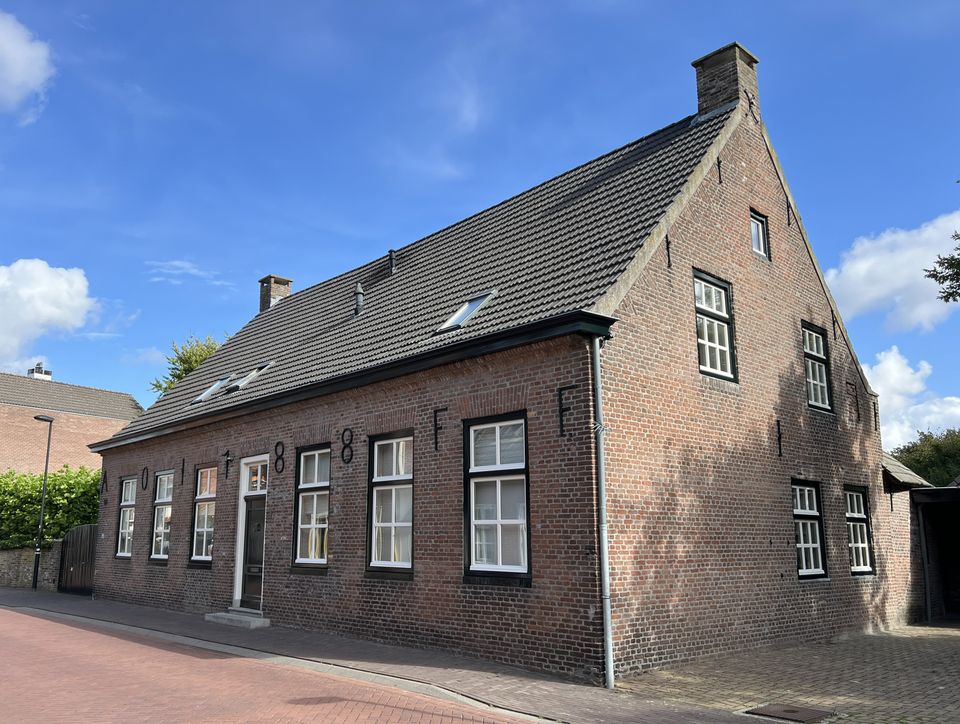
Wide house
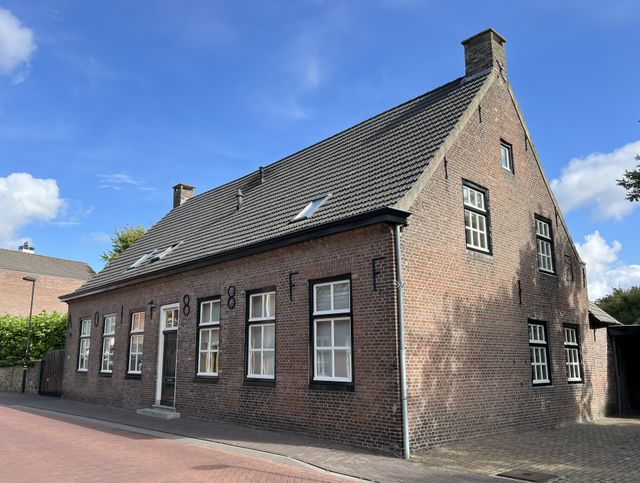
On Burgemeester Frenckenstraat stands one of the oldest surviving houses in Asten: the property bearing the wall anchors AO 1788 FF. This inscription refers to the year 1788 and the initials of the builder, Franciscus Fransen. The house was built on a plot that had been inhabited since the 17th century. It passed into the hands of Fransen through inheritance, and in 1788 he had a new, solid Brabant-style village house built. The characteristic corbelled course at the top of the façade is a typical architectural feature of that period.
A distinguished street with prominent residents
Burgemeester Frenckenstraat – formerly Binnens…
On Burgemeester Frenckenstraat stands one of the oldest surviving houses in Asten: the property bearing the wall anchors AO 1788 FF. This inscription refers to the year 1788 and the initials of the builder, Franciscus Fransen. The house was built on a plot that had been inhabited since the 17th century. It passed into the hands of Fransen through inheritance, and in 1788 he had a new, solid Brabant-style village house built. The characteristic corbelled course at the top of the façade is a typical architectural feature of that period.
A distinguished street with prominent residents
Burgemeester Frenckenstraat – formerly Binnenstraat – was a notably upmarket street in the 18th and 19th centuries. Hardly any farmers lived here. The residents were judges, doctors, merchants, civil servants and manufacturers. Among them were, for example, magistrate Jacobus Losecaat, civil bailiff Theodorus Johannes Sengers, and mayors Jan Georg and his son Fried Frencken.
The house, built in 1788, fits perfectly into this streetscape. Following the death of Franciscus Fransen, it was sold in 1817 to the Belgian physician Michiel Jacobus Aertnijs. Ten years later, it was purchased by the German cotton manufacturer David Horn, who also lived at the castle for a time. In the early 20th century, it was home to Gerardus Hendriks, the publisher of the newspaper *De Zuid-Willemsvaart*.
Dr Schreppers and the Bavarian brewery
One notable resident was Dr Johannes Schreppers, who bought the property in 1879 for 3,500 guilders. As well as being a doctor, Schreppers also owned a Bavarian brewery in Asten. That brewery stood close to where Prins Bernhardstraat 46b is now.
From butcher’s shop to the Van Kemenade residence
In 1923, butcher Driekske van Kemenade bought the house, and his grandson later lived there. The house was renovated towards the end of the 20th century, but the historic core and the façade with its wall anchors have been preserved.
This house is therefore a tangible reminder of a period when Burgemeester Frenckenstraat was a street of dignitaries, entrepreneurs and administrators. The listed building, dating from 1788, is one of the best-preserved examples of an early Brabant village house in Asten.