
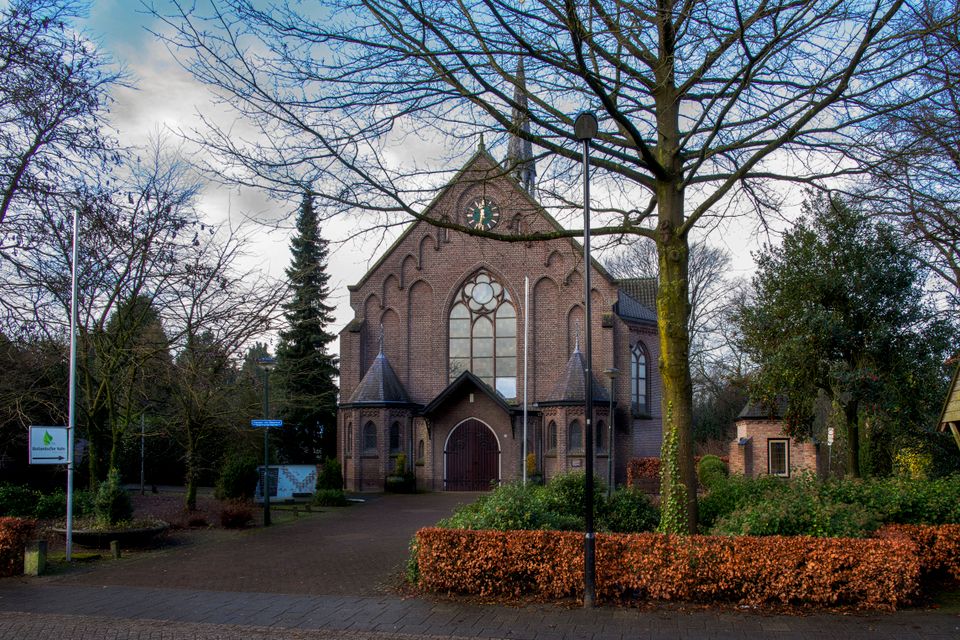
Church of the holy Antonius of Padua
Contact
Vorstermansplein
5725 AM Asten-Heusden Plan your route to Church of the holy Antonius of Padua
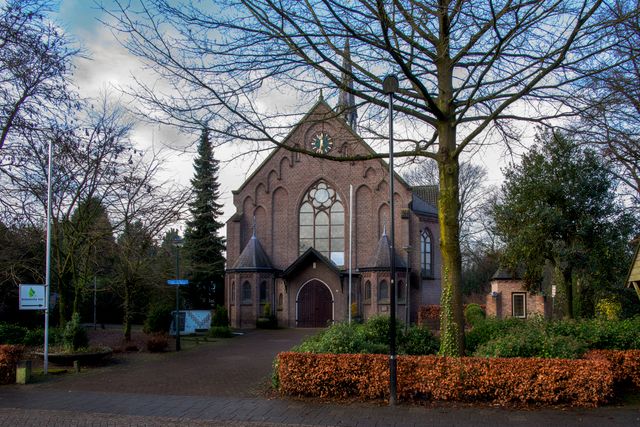
Roman Catholic church of St Anthony of Padua
The church was built in less than a year. The residents of the hamlet of Heusden were keen to have their own church. They therefore decided to set up a shop. The proceeds from this shop were to be used to establish the school and the church.
The residents of the hamlet of Heusden had long hoped for and asked for their own church. They had decided to set up a ‘Co-operative Shop’: the driving force behind this was Mr L. Koppens. The proceeds from this organisation were to be used to establish a school and a church.
The school was completed in Septembe…
Roman Catholic church of St Anthony of Padua
The church was built in less than a year. The residents of the hamlet of Heusden were keen to have their own church. They therefore decided to set up a shop. The proceeds from this shop were to be used to establish the school and the church.
The residents of the hamlet of Heusden had long hoped for and asked for their own church. They had decided to set up a ‘Co-operative Shop’: the driving force behind this was Mr L. Koppens. The proceeds from this organisation were to be used to establish a school and a church.
The school was completed in September 1919. From that moment on, the lack of a church became increasingly acute. It was with great joy that the appointment of Father Arnold was announced on 13 December 1920. This curate in Asten was appointed by the Bishop of Den Bosch, Mgr. A. Diepen, as the founding priest of the new parish of Heusden. On 12 December 1920, the founding charter was read out during all Holy Masses in the church at Asten.
The new church was to be named ‘St Anthony of Padua’. The boundary with the parish of Asten was the river Kleine Aa. The church was to be situated next to the Roman Catholic school. Two architects had put themselves forward. The commission was awarded to Vorstermans of Oss.
Work began on Tuesday 4 January 1921. The farmers were to carry out the groundwork. This was done using horse and cart. For this purpose, Heusden was divided into four districts, yielding a total of 61 carts. Next came the bricklaying. This began on Monday 7 March.
The rectory was built first due to a shortage of bricks. Father Arnold waited until mid-May to buy bricks for the church: ‘After all, the bricks are much cheaper then,’ he wrote in his notes. On Monday 14 March, the concrete for the church’s foundations was poured. Everything went smoothly and the weather was splendid throughout the entire construction period.
Incredibly quickly, on Wednesday 26 October 1921, the church and the churchyard were consecrated by Father Arnold. The first Holy Mass was the following day, 27 October, at 9.00 am. It was a great celebration.
Several times a year, a concert takes place in this beautiful church.